
Deed Types Recorded in Blount County
In Blount County, the Judge of Probate holds the recording authority for deeds. The office also records related land instruments. Every deed names the parties and describes the interest placed in the public record. The label matters less than the details. Wording, legal description, signatures, dates, and the recording reference carry the real weight. Alabama practice recognizes several deed forms. Read the actual instrument before drawing any conclusion about title.
| Deed Type | What It Does | Common Use |
|---|---|---|
| Warranty deed | Conveys the stated interest with title promises defined by the instrument | Ordinary sale or transfer |
| Quitclaim deed | Conveys whatever interest the grantor may hold | Family transfer or title cleanup |
| Executor or personal-representative deed | Conveys property through estate authority | Probate administration |
| Correction deed | Repairs an error in an earlier recorded instrument | Name or description correction |
| Tax deed or certificate | Records an event in the delinquent-tax process | Tax sale and later title work |
A mortgage or lien is not a deed. It records a claim or security interest, not a transfer of ownership. Follow the trail of later assignments and releases, because the original filing alone says nothing about a current balance or whether the debt was satisfied.
Blount County Deed Records Start in Probate
Deed records for Blount County live with the Probate office. The Recording and Public Records page pulls together the online land-record route. It also gathers forms, recording-fee material, maps, and property-tax resources in one place. The search system itself runs on a separate platform. Its Blount land-record landing page lays out the available paths. These include land records, probate cases, account login, instructions, terms, and help.
Start your Blount County deed search with what you know. The current owner of record works well as a grantee. A prior owner serves as a grantor. A book/page reference lands on the deed directly. Keep in mind that searching and pulling images may require an account or payment. If the index lacks the year or image you need, call Probate at 205-973-0584 for help with older deed records.
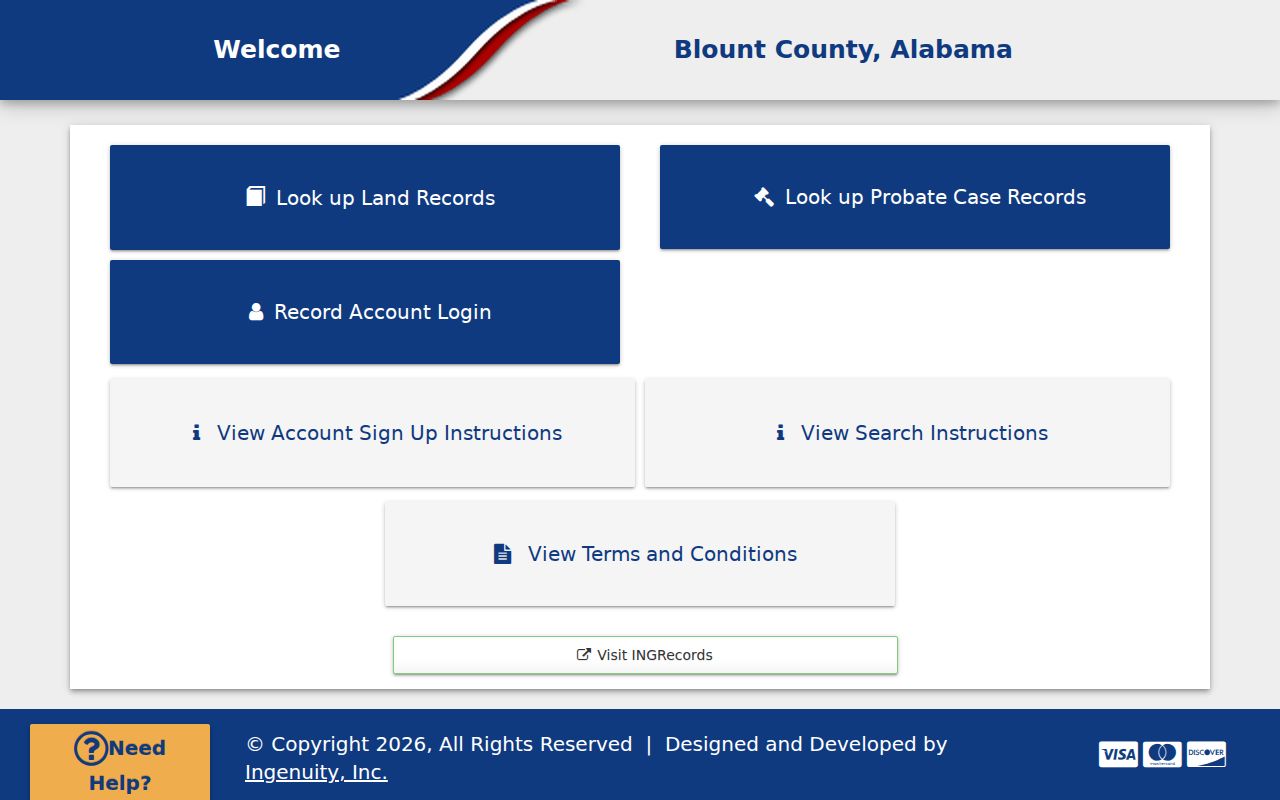
One detail stands out on the screen: land records and probate cases are separate searches. Both can affect a single chain of ownership.
References Identify Blount County Deed Records
A solid deed record holds many identifiers at once. Note the document type, grantor, grantee, execution date, recording date, book and page or instrument number, legal description, parcel reference, consideration, and whether an image exists. These details separate people who share a name and streets that sound alike.
- Grantor
- The party transferring the stated interest.
- Grantee
- The party receiving that interest.
- Book and page
- A location reference in a bound or imaged record series.
- Instrument number
- A unique recording identifier used for a filed document.
- Chain of title
- The ordered sequence of transfers tied to the same land.
Copy every reference exactly. One wrong digit or page can send a counter request to the wrong instrument entirely.
Follow Blount County Grantors Backward
Build a deed chain one recorded transfer at a time. Begin with the current grantee named on the newest deed, not just the taxpayer label. Read the grantor and the full legal description. Then search that grantor as a grantee to uncover the earlier acquisition. Repeat the process while the description keeps matching.
- Find the newest acquisition deed with the current owner named as grantee.
- Record the grantor, legal description, dates, and recording reference.
- Search that grantor as an earlier grantee and match the same land description.
- Track corrections, estate transfers, parcel splits, plats, and name variants at each step.
- Move to the Probate counter, deed books, or historical aids when the online chain ends.
- Reverse index search
- Following each transferor back to the deed by which that person acquired the land.
- Legal-description match
- Checking that the lot, block, plat, quarter section, or metes-and-bounds text describes the same tract.
- Break in chain
- A missing, mismatched, unrecorded, or unresolved transfer that needs further research.
Blount County Deed Plats Bridge Descriptions
A modern address will not always unlock a deed search. Recorded plats and map-book references can do it instead. Alabama Code §§35-4-74 and 35-2-51 govern how plat references are used and recorded. A deed may identify land by lot and block or by subdivision name. It may use a quarter section, a road, or an old place name. That wording differs from the street format on a parcel card.
Blountsville's history as the former county seat matters too. Old deeds and directories lean on Blountsville-centered geography, while later records point to Oneonta. Revenue's mapping history describes quarter-section ownership plat books used before modern GIS arrived. Keep the older wording close, and use it as a bridge to the present parcel.
Mortgages Beside Blount County Deed Records
To trace a mortgage, search the owner as mortgagor or grantor. List the lender as grantee. Then follow assignments to the current holder. A release may carry the label satisfaction, discharge, cancellation, termination, or correction. The original mortgage never shows today's unpaid balance. An assignment changes the holder without proving anything was paid.
Judgment liens may require review in both Probate and the courts. Tax liens start with Revenue but can generate recorded and court documents. A lis pendens signals pending litigation, though it decides nothing about ownership on its own. Keep the filing and the final disposition together.
Estate Transfers in Blount Deed Records
A deceased owner's name can stay on the assessment while a probate estate remains open. Search the ING probate-case route and ask the Probate office for the estate file. Identify the personal representative, heirs or devisees, court authority, and any deed or distribution instrument. Death records help with identity and chronology. They do not transfer title by themselves.
Go back to the deed index after reading the probate file. An executor's deed, personal-representative deed, affidavit, or similar instrument may supply the link. A plain grantor search may have missed it. Match the legal description rather than trusting family names alone.
Request a Blount County Deed Copy
Start with the online image if the ING account allows it. When no image appears, the Judge of Probate can help at 220 2nd Avenue East, Oneonta, AL 35121, or by phone at 205-973-0584. Include the party names, document type, recording date, and either the book and page or the instrument number. Say which copy type you want too. The county recording page posts a fee PDF, but it publishes no per-page or certification amount you can rely on without checking. Call to confirm the price and delivery method before sending any payment.
The Probate counter also serves older deed books, hard-to-read images, and gaps in the index. Written requests may work, though the address, payment method, and fulfillment procedure are best confirmed by phone rather than assumed. Keep the certification with the copy whenever an official use demands it.
Recorded, not guaranteed. Blount County deed records show filed instruments. They are not a title opinion, and an unrecorded interest or index error may still exist.
Older Blount County Deed Books
Digitization makes name searches easier, but indexing, image, account, and vendor limits come with it. A missing online hit points back to the Probate counter. It can also mean a phone call or a written inquiry. The deed books, plat books, and alternate-name searching help too. Revenue's history notes pre-GIS ownership plat books arranged by quarter section. These list owner names, parcel numbers, and assessment years across five or six year spans.
Old geography matters just as much. Blountsville served as the early county seat. Older deeds and directories may lean on roads, post-office names, or references centered on Blountsville. Oneonta's later courthouse shifted the practical hub of records work. The land stays the same even when the place vocabulary changes.
Blount County Deed Research Packet
Keep the index print or screenshot with its portal name, URL, query, and access date. Then add the current deed and at least one prior deed. Include any referenced plat, easement, correction, mortgage, assignment, or release. Compare the legal description across every item. When a court or estate record shaped the transfer, preserve the docket or order alongside the deed.
List unresolved defects rather than smoothing them over. A misspelled name or a missing book and page can each break a chain. So can a description mismatch, an unrecorded claim, or a corporate change. A missing release or a parcel split can too. That list steers the next call to Probate. It also keeps the index from being mistaken for a full title examination.
Public Access to Blount Deeds
Alabama Code §36-12-40 sets the baseline right to inspect and copy nonexempt public writings. A focused request should name the deed type, the parties, an approximate date, and a recording reference. Ask Probate about the current format, fee, and delivery method. Probate publishes no fixed response time or copy price, so confirm those details directly.
When a record is hard to identify, request index help before ordering a copy. A narrow question costs less time than a broad name search. It also reduces the chance of receiving the wrong deed.
Blount County Deed Dates Tell Stories
Execution and recording dates can differ. The first marks when the instrument was signed. The second marks its entry into the public record. A tax roll or last-sale field may update later still. Record every date shown. Resist treating one date as the date of every related event.
Corrections deserve the same care. A correction deed may repair a name, description, or reference. That repair does not signal a fresh market sale. Read the original and corrected instruments together. Estate and tax instruments can also carry consideration or transfer facts. Those facts may reflect no ordinary arm's-length deal.
Blount County Deed Names May Vary
Search names in every capacity the live index supports. Try a married name. Try initials, a suffix, an estate style, or a trustee role. The exact business name also helps when the chain warrants it. ING publishes no fixed set of name controls. Rely only on the options the live form displays.
A directory, obituary, cemetery note, or museum family file can connect two name forms. Use the clue to locate the deed. Then let the recorded instrument establish the transfer.