
Trace Former Owners of a Blount County Property
The method is a backward transfer log. Work from the present deed toward earlier instruments, recording only the dates the documents themselves show. When the online trail stops, change channels instead of assuming a fixed cutoff year.
| Transfer date | Grantor to grantee | Deed type | Book/page or instrument |
|---|---|---|---|
| Newest verified date | Immediate prior owner to current grantee | Copy the instrument label | Exact locator from Probate/ING |
| Earlier verified date | Next prior owner to that grantor | Warranty, quitclaim, estate, or other shown type | Exact earlier locator |
| Older book entry | Names as indexed in the historical volume | As written in the book | Deed book and page |
Never fill a blank row by guessing. Each step rests on a document describing the same tract, not merely two people who share a name.
Use the Blount County Probate Index for Prior Owners
The Blount County Judge of Probate is the recording office. Deeds, mortgages, releases, liens, and plats all file there. Its ING landing page separates land records from probate cases. It also links instructions for public access. Start with the current grantee, pull the deed that conveyed the tract, then read who signed as grantor. Useful fields cover instrument number or book/page, recording and execution dates, grantor and grantee, vesting, legal description, parcel reference, exceptions, and easements. Search spelling variants too. Try initials, spouses, trustees, estates, and entity names. Vendor terms forbid scraping and automated systems. So use the portal as presented and note your search date.
See the Blount County Records Doorway Before Going Back
The Blount Probate recording page links online records, fees, maps, and forms.
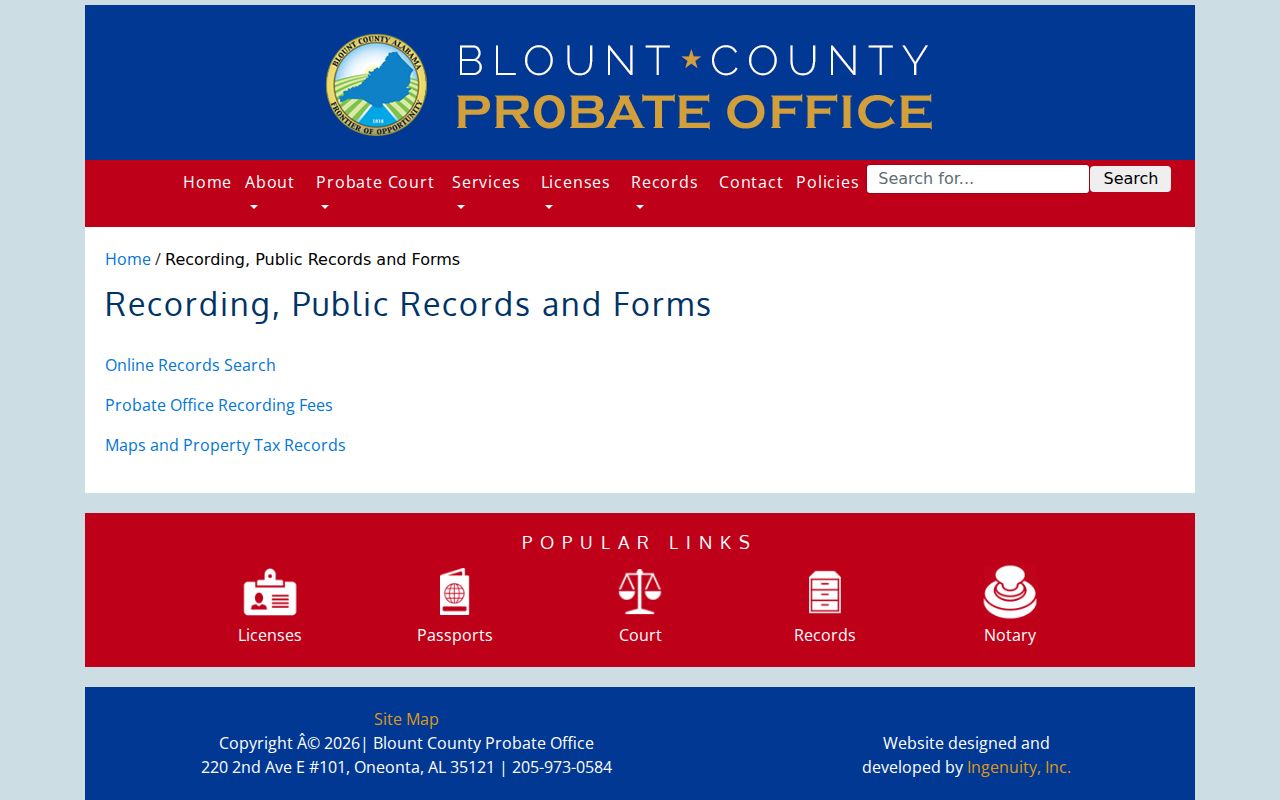
The official records doorway is the route worth learning first. It does not reveal the index's earliest year, and some historic images may never have gone online.
Walk the Blount County Deed Chain Backward
The search moves in reverse. Each deed transfers the same land while the names change at every conveyance.
- Find the current acquiring deed with the present owner shown as grantee.
- Record the grantor, legal description, date, and cited prior instrument or plat.
- Search that grantor as a grantee and locate how the same tract reached that person.
- Repeat until the online index or image trail ends, then request the cited deed book at Probate.
- Grantor and grantee
- The conveyor and recipient named in an instrument.
- Chain of title
- The ordered sequence of instruments affecting the tract.
- Reverse index
- An index organized to support searching the opposite party role.
- Warranty and quitclaim deeds
- Different forms whose legal effect must be read from the instrument, not guessed from the index label.
Translate Old Blount County Maps Without Losing the Chain
Before 1971, plat books listed owners by quarter section. One book could span five or six assessment years. The Revenue Department points to Weissinger v. Boswell, Alabama Act 160, later aerial work, and county-employed mappers after 1980 as milestones in the modern mapping system. An old deed may cite a quarter section instead. It may also name a rural route, a former road, a school, a church, or a post office. Record that phrase in your notes. Compare it against the deed's calls, an old map sheet, and the current parcel. Never force an old holding into a modern polygon without documentary support.
Connect Blount County Previous Owners Through Recorded Plats
Recorded plats keep a lot's history attached when street addresses change. Four Blount County examples show the citation format. Lake Nola Subdivision sits at Plat Book 1, page 159. Hidden Creek Lot 16 appears at Map Cabinet A, Volume 104, pages 6 through 7. Skyview Lakeridge Estates First Sector is at Map Book 2, page 47. Hayden Highlands Plat One is at Map Cabinet A, Slide 118, page 3. Copy the exact subdivision, lot, block, cabinet, slide, book, and page from the deed. A neighborhood name alone proves little. Plats change over time. Municipal lines may not follow platted boundaries.
Repair a Blount County Former Owner Gap Through Probate
A tidy grantor-grantee chain can still break. Sometimes the owner died first. Estate conveyances, survivorship language, and fiduciary signatures in another capacity can all hide a transfer. Search the decedent, the estate, the executor or administrator, the spouse, and the case number. Wills, letters, and estate-sale deeds may help. Other gaps include unindexed pages, misspelled names, description mismatches, correction deeds, corporate name changes, split or merged parcels, and missing mortgage releases. Keep a list of unresolved links.
Blount County Former Owners Cross Two County-Seat Eras
Blount County dates to 1818. Blountsville served as the early county seat until the late nineteenth century. Oneonta, incorporated in 1891, became the courthouse center later. Older deeds, businesses, roads, and directory entries can lean on Blountsville geography. Even a modern search may start from Oneonta or another postal name. The Blount County Memorial Museum and Genealogy Research Center holds more than 500 volumes. It also keeps more than 1,000 family files. Deed abstracts, cemetery surveys, local histories, clippings, and family files can explain a name change. They can also explain a place clue. The recorded deed still establishes the conveyance.
Continue Blount County Prior Owners Beyond the Online Index
The ING index publishes no confirmed earliest year. Treat any claimed cutoff with caution. When a citation or image disappears online, contact the Probate office at the Blount County Courthouse. Give the exact book/page or party and date range. Ask about counter, copy, or written-request options. Confirm current fees from the linked county fee document rather than borrowing another county's rates. For older context, try the museum, Alabama Department of Archives and History finding aids, and library or FamilySearch catalogs. Ask each repository about its years and restrictions. A directory, obituary, census, or cemetery entry can connect people and addresses, but none substitutes for a deed.
The Probate main office sits at 220 2nd Avenue East in Oneonta. Its staff can be reached at 205-973-0584. The Hayden Annex handles only limited services. Call ahead to confirm it can pull an older book or produce a copy. A written request works best when it names the parties, the approximate date, and the instrument type. Also include the exact book and page if known. Add a tract or subdivision description, the format you want, and your contact details.
Clues from local collections deserve precise citations. Note the collection title, year, page, place name, and repository for each one. A directory might place a former owner at an address. A cemetery record can narrow a death date, while a newspaper notice may reveal an estate sale or road change. Every clue should point back to the deed or Probate file. It should not stand in for conveyance evidence itself.
Know How Far Blount County Ownership Records Go
Blount County's recordkeeping reaches back to the territorial-era county. No verified first deed-book date, complete film run, or online start year can be stated with confidence. The answer is source by source. Start with the current recorded citation, then move into physical deed and plat books when the chain requires it. Archives supply older government and community context from there.
No assumed cutoff. Do not claim an earliest Blount County former-owner year until Probate or a verified catalog supplies the actual coverage.
Prior owners can illuminate house history, estate questions, plats, easements, and a purchase review. Public access has limits, though. It never permits stalking, harassment, threats, doxxing, or misuse of protected personal data.
Build the final chronology with separate columns for execution date and recording date. The two can differ. Retain the deed type exactly as indexed. Note any reservations, easements, exceptions, spouse or fiduciary capacities, and referenced releases. Consideration may appear in the record, but it is not automatically a market price. A correction or replacement instrument can surface in the deed records. Do not count it as a new arm's-length ownership event without reading its substance.